
Abstract
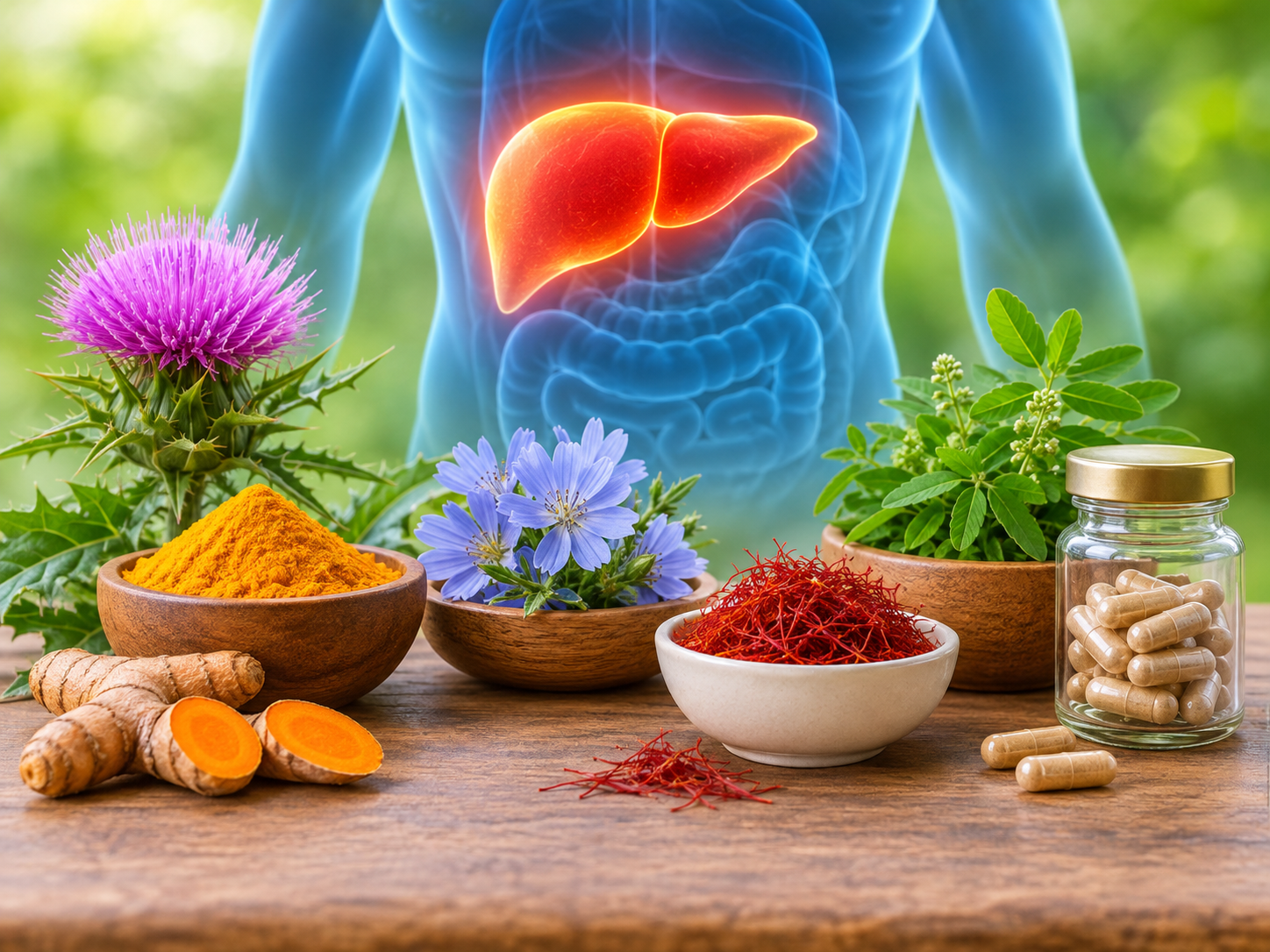
The liver clears toxins on its own, and no herb has been proven to “cleanse” it in healthy people. Still, many adults in India and elsewhere use herbal and Unani preparations to support liver health, often without clear guidance on which ingredients have research behind them or what risks they carry. This article reviews five commonly used botanicals: milk thistle (silymarin), turmeric (curcumin), Kasni (chicory, Cichorium intybus), saffron (Zafran) and Bhumi amla (Phyllanthus). It draws on primary clinical trials, systematic reviews and meta-analyses, and labels preclinical studies as such. Evidence is strongest for silymarin. A 2024 meta-analysis of 26 randomised trials (2,375 patients) found lower ALT and AST and improved liver fat in people with non-alcoholic fatty liver disease, although a 48-week biopsy-based trial missed its primary endpoint. Curcumin modestly lowered liver enzymes in a meta-analysis of 15 trials, yet a US research network has documented turmeric-associated liver injury, including one death. Available primary evidence for Kasni comes largely from animal studies. Saffron improved inflammatory markers but not liver enzymes in a 76-patient trial, and Cochrane reviews found insufficient evidence for Phyllanthus in hepatitis B. Indian case series also show that herbal products can themselves injure the liver, particularly when contaminated, adulterated or unlabelled. We conclude that herbal liver support is best viewed as a complement to medical care, alcohol reduction, weight management and a healthy diet, not a substitute for them. Readers should choose licensed, fully labelled products, avoid combining several herbal supplements, and seek medical advice before use if they have liver disease or take regular medicines.
Can You Really “Cleanse” Your Liver?
Your liver already filters blood, processes medicines and breaks down toxins around the clock. No herbal supplement has been shown to “flush” it in a healthy person, so claims of a quick detox deserve scepticism. A more useful question is which herbs may support liver function, what the evidence says about each, and how to use them without adding risk.
That question matters more every year, as fatty liver disease becomes increasingly common. Many people look to an Ayurvedic medicine for liver health, a herbal Unani liver tonic or a herbal liver detox formula as a gentle, traditional option. But “natural” does not automatically mean safe. A 2026 analysis of 386 alternative medicine products taken by 91 patients at a South Indian centre found hepatotoxic botanicals, heavy-metal contamination and adulteration among the problems behind liver injury [1].
This guide reviews five herbs using human trials and systematic reviews wherever they exist. It labels animal research as such and says plainly where the evidence is thin.
Five Herbs Worth Knowing, and What the Evidence Says
1. Milk Thistle (Silymarin)
Milk thistle (Silybum marianum) is the most extensively studied herbal liver supplement, and its active extract is called silymarin. A 2024 systematic review and meta-analysis pooled 26 randomised controlled trials with 2,375 patients who had non-alcoholic fatty liver disease (NAFLD) or steatohepatitis. Silymarin was associated with lower ALT and AST levels and improved hepatic steatosis on histology. The authors stressed that further research is needed to confirm the findings [2].
Individual trials are less clear-cut. In a 48-week placebo-controlled trial of 99 adults with biopsy-proven NASH, silymarin at 700 mg three times daily did not meet its primary goal of a 30% or greater fall in NAFLD activity score. However, more patients in the silymarin group improved by at least one fibrosis point (22.4% versus 6.0%), and the treatment was safe and well tolerated [3].
What this means: silymarin has a reasonable evidence base for supporting liver enzymes in fatty liver, but it is not a proven treatment for advanced disease.
2. Turmeric and Curcumin
Turmeric (Curcuma longa) and its pigment curcumin are among the most popular Ayurvedic ingredients. A 2025 meta-analysis of 15 randomised trials (905 people with NAFLD) found that curcumin lowered ALT by about 4.1 IU/L and AST by about 3.3 IU/L compared with control, with no effect on ALP. Curcumin combined with piperine, the black pepper compound often added to boost absorption, showed no significant effect on ALT or AST [4]. An earlier systematic review suggested that benefits, particularly for AST, may depend on dose and duration [5]. The average improvement is modest.
Turmeric also carries a safety signal that every reader should know about. The US Drug-Induced Liver Injury Network reported ten cases of turmeric-associated liver injury, all enrolled since 2011. Five patients were hospitalised and one died of acute liver failure. Injury was typically hepatocellular and appeared one to four months after starting. Seven of the ten patients carried the gene variant HLA-B*35:01, and three of the seven products tested also contained piperine [6].
What this means: curcumin may modestly help liver enzymes in fatty liver, but concentrated supplements are not risk-free. Stop and seek medical advice if jaundice, dark urine or severe fatigue develops.
3. Kasni (Chicory Seed)
Kasni (Cichorium intybus) seed is a classic ingredient in Unani liver preparations, and it shows why tradition and trial evidence are not the same thing. The research we found is preclinical. In an animal model of carbon tetrachloride-induced liver injury, an alcoholic extract of Kasni had a significant hepatoprotective effect on ALT, AST and ALP, whereas the aqueous extract did not [7]. A 2024 study of a chicory formulation prepared according to the Unani Pharmacopoeia reported hepatoprotective activity in rats, with recovery of liver architecture that exceeded the silymarin reference drug [8].
These results are encouraging, but they come from animals given a chemical toxin, which is very different from everyday human liver stress. Well-designed human trials are still needed.
What this means: Kasni is traditionally valued and biologically plausible as a liver tonic ingredient, but its benefits in people remain unproven.
4. Saffron (Zafran)
Saffron (Crocus sativus) appears in many Unani tonics. In a double-blind randomised trial of 76 NAFLD patients, 100 mg of saffron daily for 12 weeks improved some inflammatory, oxidative-stress and adipokine markers. It did not significantly change ALT, AST or body composition [9]. In rats fed a high-fat diet, saffron extract and its pigment crocin dose-dependently lowered liver enzymes and eased fatty-liver tissue changes [10].
What this means: saffron may support the inflammatory and oxidative picture in fatty liver, but there is no human evidence yet that it improves liver enzymes.
5. Bhumi Amla (Phyllanthus)
Bhumi amla (Phyllanthus species) is widely promoted for jaundice and hepatitis, so it is worth being precise. A Cochrane review compared Phyllanthus with antiviral drugs in chronic hepatitis B. It found five trials with 290 patients, all at high risk of bias, and concluded there is currently insufficient evidence to support or refute its use. Adverse-event reporting was almost absent, so safety could not be judged [11]. An earlier systematic review of 22 trials (1,947 patients) saw possible benefits on antiviral activity and liver chemistry, but called the evidence weak because of poor trial quality and variation between herb preparations [12].
What this means: Phyllanthus should never replace prescribed antiviral treatment, and anyone with a viral hepatitis diagnosis should follow their hepatologist’s plan.
Where Traditional Unani Formulations Fit
Traditional practitioners rarely rely on a single herb. Unani majoon and habb preparations blend many ingredients, so the research above applies to individual herbs rather than to finished products. Livosha M (100 g paste) from Shahi Herbal is one such herbal liver detox formula in the Unani tradition. Its label lists 19 ingredients, including Tukhm Kasni (chicory seed), Zafran (saffron), Majeth (Manjistha) and Tukhm Kasoos, in a sugar base.
None of the studies cited in this article tested Livosha M itself, so it is best viewed as a traditional formulation rather than a clinically proven treatment. Because of the sugar base, people with diabetes should check with their physician first, and everyone should follow the label directions.
How to Use Herbal Liver Support Safely
Choose Licensed, Fully Labelled Products
Indian data suggest the product can matter as much as the plant. In the 386-product analysis, heavy-metal contamination and adulteration were widespread, and use of unlabelled products significantly predicted death [1]. Buy only from manufacturers holding the relevant AYUSH licence, check ingredient lists and batch details, and avoid unmarked “liver cleanse” powders.
Know When to Be Cautious
Even single-herb products can injure the liver. In an Indian multi-centre case series, ashwagandha was linked mainly to cholestatic hepatitis. Three patients with underlying chronic liver disease presented with acute-on-chronic liver failure, and all three died on follow-up [13]. Sensible precautions include:
Speak to a doctor before starting any herb if you have liver disease, are pregnant or take regular medicines.
Avoid taking several herbal products at once, because it makes the cause hard to identify if something goes wrong.
Stop and seek care for yellow eyes or skin, dark urine, pale stools, persistent itching or unexplained nausea.
Remember that limiting alcohol, keeping a healthy weight and staying active remain the foundation of liver health.
Conclusion
Herbs can play a supporting role in liver care, but the evidence differs widely. Silymarin is the best studied. Curcumin offers modest enzyme benefits alongside a documented risk of rare liver injury. Kasni, saffron and Phyllanthus need stronger human trials. The safest approach is to treat herbal liver support as a complement to medical care, choose licensed and labelled products, and talk to a doctor before starting, especially if you already have liver disease. This article is for information only and is not medical advice.
References
- Philips CA, Oommen TT, Theruvath AH, Sreemohan A, Baby A, Ahamed R, Tharakan A, Augustine P. Analysis of 386 alternative medicinal products implicated in liver injury reveal clinically relevant associations with potentially hepatotoxic botanicals, pharmaceutical adulteration, heavy metal contamination, and undisclosed animal content. Front Gastroenterol. 2026. doi:10.3389/fgstr.2026.1784785
- Li S, Duan F, Li S, Lu B. Administration of silymarin in NAFLD/NASH: a systematic review and meta-analysis. Ann Hepatol. 2024;29(2):101174. doi:10.1016/j.aohep.2023.101174. PMID: 38579127
- Wah Kheong C, et al. A randomized trial of silymarin for the treatment of nonalcoholic steatohepatitis. Clin Gastroenterol Hepatol. 2017. doi:10.1016/j.cgh.2017.04.016. PMID: 28419855
- Vajdi M, Hassanizadeh S, Hassanizadeh R, Bagherniya M. Curcumin supplementation effect on liver enzymes in patients with nonalcoholic fatty liver disease: a GRADE-assessed systematic review and dose–response meta-analysis of randomized controlled trials. Nutr Rev. 2025;83(1):1–12. doi:10.1093/nutrit/nuad166
- Mansour-Ghanaei F, Pourmasoumi M, Hadi A, Joukar F. Efficacy of curcumin/turmeric on liver enzymes in patients with non-alcoholic fatty liver disease: a systematic review of randomized controlled trials. Integr Med Res. 2019;8(1):57–61. doi:10.1016/j.imr.2018.07.004. PMID: 30949432
- Halegoua-DeMarzio D, Navarro V, Ahmad J, et al. Liver injury associated with turmeric: a growing problem. Ten cases from the Drug-Induced Liver Injury Network (DILIN). Am J Med. 2023;136(2):200–206. doi:10.1016/j.amjmed.2022.09.026. PMID: 36252717
- Nadeem N, et al. Hepatoprotective effect of Cichorium intybus Linn (Kasni) extracts against carbon tetrachloride induced liver damage. J Rawalpindi Med Coll. 2009;13(2). https://mail.journalrmc.com/index.php/JRMC/article/view/718
- Siddiqa A, Qureshi R, et al. Liver-boosting potential: chicory compound-mediated silver nanoparticles for hepatoprotection: biochemical and histopathological insights. Front Pharmacol. 2024;15:1325359. doi:10.3389/fphar.2024.1325359
- Kaviani Pour F, Aryaeian N, Mokhtare M, et al. The effect of saffron supplementation on some inflammatory and oxidative markers, leptin, adiponectin, and body composition in patients with nonalcoholic fatty liver disease: a double-blind randomized clinical trial. Phytother Res. 2020. doi:10.1002/ptr.6791. PMID: 32798261
- Mashmoul M, Azlan A, Mohtarrudin N, et al. Protective effects of saffron extract and crocin supplementation on fatty liver tissue of high-fat diet-induced obese rats. BMC Complement Altern Med. 2016. doi:10.1186/s12906-016-1381-9
- Xia Y, Luo H, Liu JP, Gluud C. Phyllanthus species versus antiviral drugs for chronic hepatitis B virus infection. Cochrane Database Syst Rev. CD009004.pub2. doi:10.1002/14651858.CD009004.pub2
- Liu J, Lin H, McIntosh H. Genus Phyllanthus for chronic hepatitis B virus infection: a systematic review. J Viral Hepat. 2001;8(5):358–366. doi:10.1046/j.1365-2893.2001.00307.x
- Philips CA, Valsan A, Theruvath AH, et al. Ashwagandha-induced liver injury: a case series from India and literature review. Hepatol Commun. 2023;7(10):e0270. doi:10.1097/HC9.0000000000000270


