
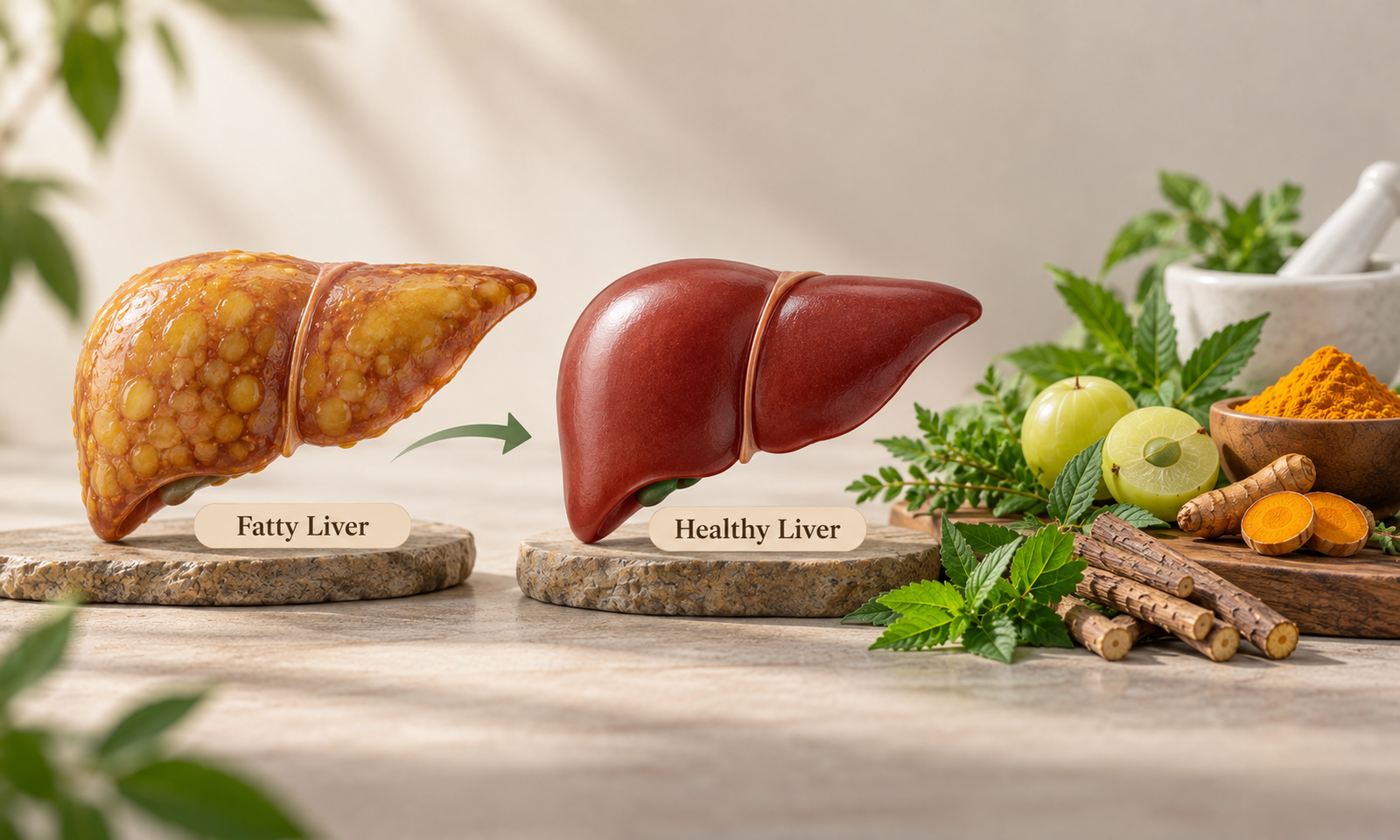
Abstract
Fatty liver disease is increasingly associated with obesity, insulin resistance, type 2 diabetes, abnormal blood lipids and sedentary lifestyles. The terminology has also evolved: what was traditionally called non-alcoholic fatty liver disease (NAFLD) is now commonly referred to as metabolic dysfunction-associated steatotic liver disease (MASLD) when hepatic steatosis occurs with cardiometabolic risk factors.
Ayurveda has traditionally emphasized dietary discipline, physical activity, digestion, metabolic balance and the use of medicinal plants. Modern research is beginning to investigate whether some Ayurvedic herbs and formulations can complement these approaches in people at risk of fatty liver. Studies have examined preparations containing turmeric, Phyllanthus species, Kutki and other herbs, with some reporting improvements in liver enzymes, liver fat or metabolic markers.
However, current scientific evidence does not establish that Ayurvedic medicine alone can prevent fatty liver. The strongest evidence for prevention remains associated with maintaining a healthy weight, regular physical activity, a balanced diet and management of diabetes and other metabolic risk factors. Some herbal preparations show promising results, but their effects are formulation-specific and require further high-quality clinical research.
A responsible approach therefore combines traditional Ayurvedic knowledge with modern evidence: using appropriate herbs as potential complementary support while prioritizing proven lifestyle measures and medical evaluation when liver abnormalities are present.
What Is Fatty Liver?
Fatty liver refers to excessive accumulation of fat within liver cells. When this occurs in association with metabolic risk factors such as overweight or obesity, type 2 diabetes or abnormal lipid levels, the condition is now commonly classified as metabolic dysfunction-associated steatotic liver disease (MASLD).
MASLD exists on a spectrum. Some people have relatively simple accumulation of liver fat, while others can develop metabolic dysfunction-associated steatohepatitis (MASH), inflammation, fibrosis and eventually cirrhosis. The 2024 EASL-EASD-EASO clinical practice guidelines emphasize that people with metabolic risk factors, abnormal liver enzymes or evidence of liver steatosis may require assessment for fibrosis risk.
The good news is that early fatty liver is often responsive to changes in lifestyle and metabolic health. This is where an Ayurvedic approach can potentially complement modern preventive strategies.
How Can Ayurveda Support Liver Health?
Ayurveda traditionally approaches health through interconnected factors including diet, digestion, daily routine, physical activity and medicinal plants. Some of these principles overlap with modern strategies for reducing metabolic risk.
However, it is important not to equate traditional concepts directly with modern liver-disease diagnoses. Modern clinical evidence evaluates outcomes such as liver fat, ALT and AST levels, insulin resistance, body weight and fibrosis measurements.
A 2025 review specifically examining Indian traditional remedies for NAFLD identified 58 relevant studies and 12 clinical trials involving Ayurveda, Unani and Siddha approaches. The authors described herbal interventions as promising but also highlighted the need for additional clinical research.
Thus, Ayurvedic medicine may have a role as a complementary approach to liver-health management, but it should not be described as a replacement for evidence-based diagnosis and treatment.
1. Maintaining a Healthy Weight
Among all strategies for preventing metabolic fatty liver, weight management has some of the strongest evidence.
Excess body fat, particularly visceral fat, is closely associated with insulin resistance and metabolic dysfunction. These processes can increase the delivery and storage of fatty acids in the liver.
The EASL-EASD-EASO guidelines recommend lifestyle modification involving weight loss, dietary changes and physical activity for adults with MASLD.
The American Association for the Study of Liver Diseases also identifies weight reduction as an important component of MASLD management, noting that a 5–10% reduction in body weight is associated with meaningful improvements in hepatic steatosis and inflammation.
From an Ayurvedic perspective, dietary moderation and regular physical activity are consistent with the broader emphasis on maintaining metabolic balance.
Therefore, an ayurvedic medicine for liver health should not be viewed independently of lifestyle. A herbal product cannot compensate for persistent overeating, inactivity or uncontrolled metabolic disease.
2. Following a Liver-Friendly Diet
Diet is another major factor influencing fatty liver risk.
Current clinical guidance emphasizes reducing excessive energy intake and improving overall dietary quality. The 2024 international expert consensus on dietary modification for MASLD recommends greater consumption of whole grains, plant-based proteins, fish, vegetables and deeply colored fruits and vegetables, while reducing ultra-processed foods, added sugars, saturated and trans fats, processed meats and excessive alcohol.
Many traditional Indian dietary practices naturally include vegetables, legumes, whole grains, fruits, spices and plant-based foods. However, not every traditional dietary practice has been clinically tested for fatty liver prevention.
A practical approach is therefore to combine traditional food wisdom with established nutritional evidence rather than assuming that every Ayurvedic dietary recommendation has been clinically proven to prevent MASLD.
3. Turmeric and Curcumin
Turmeric (Curcuma longa) is one of the most extensively studied Ayurvedic spices in modern liver research.
Curcumin, one of turmeric’s major bioactive compounds, has antioxidant and anti-inflammatory properties. Several randomized controlled trials have investigated curcumin supplementation in people with fatty liver disease.
A 2024 systematic review and meta-analysis included 14 randomized clinical trials and reported significant reductions in ALT and AST among people with NAFLD who received curcumin. However, the analysis showed substantial statistical heterogeneity between studies, meaning that the results varied considerably among trials.
Another 2024 meta-analysis included 15 randomized controlled trials involving 835 participants and found that curcumin reduced AST but did not significantly reduce ALT, again with substantial heterogeneity.
These findings are encouraging but do not establish turmeric as a proven preventive treatment for fatty liver.
It is also important to distinguish culinary turmeric from standardized curcumin supplements. Research often uses concentrated extracts at specific doses that cannot simply be equated with the amount of turmeric consumed in food.
4. Phyllanthus Species and Bhumyamalaki
Several Phyllanthus species have a long history in traditional Indian medicine and have been investigated for potential hepatoprotective effects.
Research into Phyllanthus niruri and related species has produced mixed clinical results. A randomized, double-blind, placebo-controlled trial evaluated standardized P. niruri extract in adults with mild-to-moderate NAFLD over 12 months. The study was designed to assess changes in liver fat and metabolic markers, illustrating that the plant has progressed beyond purely laboratory research.
However, evidence from other clinical studies has not consistently demonstrated clinically meaningful benefits for every liver condition. For example, a randomized trial of Phyllanthus in biopsy-proven NASH did not find a significant improvement in the NAFLD activity score compared with placebo.
This illustrates an important principle for herbal medicine: promising biological activity does not necessarily translate into a clinically meaningful benefit.
5. Kutki and Other Traditional Liver Herbs
Kutki (Picrorhiza kurroa) has a long traditional association with liver-related Ayurvedic preparations. Its major constituents include iridoid glycosides such as picrosides.
Other Ayurvedic formulations containing Kutki and multiple herbs have also been studied in patients with fatty liver disease.
A clinical study of Katukyadi Churna, an Ayurvedic polyherbal preparation, evaluated patients with non-alcoholic steatohepatitis using elastographic assessment. The investigators reported changes after six months of intervention, although the study was a single-arm trial with a small enrolled population.
Another randomized placebo-controlled clinical trial investigated Sharapunkhadi powder alongside lifestyle modification and reported improvements in fatty-liver grading after eight weeks. The researchers concluded that the combination appeared promising, but the evidence remains formulation-specific.
Such studies provide useful research signals, but they do not establish that every Kutki-containing or Ayurvedic formulation will produce the same effect.
6. Ayurvedic Formulations and Emerging Clinical Evidence
Research in this field is continuing to develop.
A 2026 randomized controlled clinical study evaluated Ayulite, an 11-herb Ayurvedic formulation, against vitamin E in patients with NAFLD. Sixty-seven participants were randomized, with 61 included in the final analysis. After 90 days, complete recovery from the study-defined fatty-liver grades occurred in 4 of 29 participants in the Ayulite group and 7 of 32 in the vitamin E group, with no statistically significant difference between the groups. The researchers reported comparable safety and described the formulation as a potential herbal option, while the relatively short duration and sample size limit how broadly the results can be applied.
A separate 2026 randomized, placebo-controlled exploratory trial investigated an oral nutraceutical containing turmeric extract, dandelion, milk thistle and ginger in 30 people with MASLD. After 60 days, the intervention group had a greater improvement in ultrasound-based fatty-liver grading than the placebo group. However, the researchers explicitly identified the small sample size, single-center design and short duration as limitations.
These newer studies demonstrate why the subject deserves continued research, but they should not be interpreted as definitive proof that Ayurvedic medicines can independently prevent fatty liver.
7. Combining Herbal Support With Physical Activity
Exercise is one of the most important components of fatty-liver prevention and management.
The 2024 European clinical guidelines recommend physical exercise as part of lifestyle management for MASLD. Both aerobic and resistance exercise can be incorporated according to an individual’s abilities and medical circumstances.
This is particularly relevant when discussing Ayurveda because traditional health practices often emphasize physical activity and daily routines. Some contemporary research is also investigating yoga-based interventions for metabolic dysfunction-associated steatotic liver disease, although the evidence base is still developing.
A practical liver-health routine can therefore focus on regular movement, reduced sedentary time, appropriate calorie intake and gradual weight management, with herbal products considered only as complementary options where appropriate.
Can Ayurvedic Medicine Prevent Fatty Liver on Its Own?
Current evidence does not justify claiming that Ayurvedic medicine alone can prevent fatty liver.
The strongest evidence continues to support lifestyle measures: maintaining a healthy body weight, following a balanced diet, exercising regularly, limiting alcohol exposure and controlling conditions such as diabetes and dyslipidemia. The 2024 EASL-EASD-EASO guidelines identify lifestyle modification and management of metabolic risk factors as central components of MASLD care.
Herbal research is nevertheless becoming increasingly interesting. A 2025 review of Ayurvedic, Unani and Siddha approaches identified numerous herbal interventions and clinical studies, but the authors also noted the need for further research.
For consumers searching for an Herbal liver detox formula, it is important to understand that the liver already performs its own metabolic and detoxification functions. There is no established need for periodic “detoxification” of a healthy liver. A better evidence-based approach is to support the factors that reduce metabolic stress on the liver.
Likewise, someone considering a Herbal Unani liver tonic should evaluate the actual ingredients, evidence, dosage and safety profile rather than assuming that a traditional label guarantees effectiveness.
Safety Considerations for Ayurvedic Liver Products
Herbal medicines should not automatically be considered harmless because they are natural.
The U.S. National Center for Complementary and Integrative Health notes that safety varies by product and that some Ayurvedic preparations have been found to contain potentially toxic amounts of heavy metals such as lead, mercury or arsenic. It also emphasizes that interactions and contamination are important safety considerations for herbal products.
Product quality is therefore particularly important when an herbal formulation is intended for repeated use.
People who already have liver disease, take prescription medicines, are pregnant or breastfeeding, or have other chronic health conditions should discuss herbal products with an appropriately qualified healthcare professional before using them regularly.
An evidence-based ayurvedic medicine for liver health should therefore be presented with transparent information about its ingredients, intended use, dosage, available research and safety considerations.
A Practical Natural Approach to Fatty-Liver Prevention
For someone interested in natural strategies, the evidence can be translated into several practical principles: maintain a healthy weight, remain physically active, reduce prolonged sedentary time, emphasize minimally processed foods, increase vegetables and whole-food plant sources, limit foods high in added sugars and unhealthy fats, avoid excessive alcohol, and manage blood glucose and lipid abnormalities.
Ayurvedic herbs such as turmeric and Phyllanthus species can be considered subjects of scientific interest, but their role should remain complementary to these established measures.
For Shahi Herbal, responsible communication around liver-health products can therefore combine traditional knowledge with current scientific evidence. Instead of presenting an herbal formulation as a guaranteed cure or “liver cleanser,” educational content can explain the traditional role of its ingredients, summarize the available clinical evidence and encourage appropriate medical assessment when fatty liver or abnormal liver tests are suspected.
Reference
- European Association for the Study of the Liver, European Association for the Study of Diabetes, European Association for the Study of Obesity. EASL-EASD-EASO Clinical Practice Guidelines on the management of metabolic dysfunction-associated steatotic liver disease (MASLD). Journal of Hepatology. 2024;81(3):492–542. DOI: 10.1016/j.jhep.2024.04.031; PMID: 38851997.
- American Association for the Study of Liver Diseases (AASLD). Steatotic Liver Disease: Cutting Through the Fat. Clinical educational resource discussing guideline-directed MASLD management and lifestyle modification.
- Vajdi M, et al. Curcumin supplementation effect on liver enzymes in patients with nonalcoholic fatty liver disease: a GRADE-assessed systematic review and dose-response meta-analysis of randomized controlled trials. Nutrition Reviews. 2024. PMID: 38213188; PROSPERO: CRD42023448231.
- Malik A, Malik M. Effects of curcumin in patients with non-alcoholic fatty liver disease: A systematic review and meta-analysis. Canadian Liver Journal. 2024;7(2):299–315. DOI: 10.3138/canlivj-2023-0022; PMID: 38746865; PMCID: PMC11089474.
- Aragón-Vela J, Sánchez-Oliver AJ, Huertas J, Casuso RA. Does curcumin improve liver enzymes levels in nonalcoholic fatty liver disease? A systematic review, meta-analysis, and meta-regression. Phytotherapy Research. 2024;38(8):4261–4271. DOI: 10.1002/ptr.8274; PMID: 38965866.
- Shivane V, et al. A prospective, randomized, controlled, open-label blinded end point clinical study of Ayulite in comparison with vitamin E for efficacy and safety in patients with non-alcoholic fatty liver disease. Journal of Ayurveda and Integrative Medicine. 2026. DOI: 10.1016/j.jaim.2026.101341; PMID: 42172812; PMCID: PMC13223948.
- Messier H, et al. Effectiveness and safety of an ayurvedic nutraceutical for improving clinical parameters of liver function in participants with metabolic dysfunction-associated steatotic liver disease: a randomized, placebo-controlled, preliminary phase 2 exploratory clinical trial. Frontiers in Nutrition. 2026. PMID: 41909037.
- Kumar et al. Exploring Herbal and Indian Traditional Remedies in the Management of Non-Alcoholic Fatty Liver Disease: Recent Advances and Clinical Trial Insights. 2025. PMID: 41411135.
- Efficacy of Sharapunkhadi powder (a polyherbal formulation) and lifestyle modification in the management of nonalcoholic fatty liver disease—A randomized placebo-controlled clinical trial. AYU. 2021. PMID: 34908794.
- Elastographic liver evaluation of Katukyadi churna in the management of Non-Alcoholic Steatohepatitis (NASH)—A single arm clinical trial. Journal of Ayurveda and Integrative Medicine. DOI: 10.1016/j.jaim.2020.12.015; PMID: 33579578; PMCID: PMC8039359.
- National Center for Complementary and Integrative Health (NCCIH). Ayurvedic Medicine: In Depth. Information concerning the evidence and safety of Ayurvedic preparations.
Keywords: ayurvedic medicine for liver health, Herbal liver detox formula, Herbal Unani liver tonic, Shahi Herbal, Ayurvedic medicine for fatty liver, Ayurvedic herbs for fatty liver, natural fatty liver support, fatty liver prevention, MASLD, NAFLD, Ayurvedic liver care, herbal liver support


