
Abstract
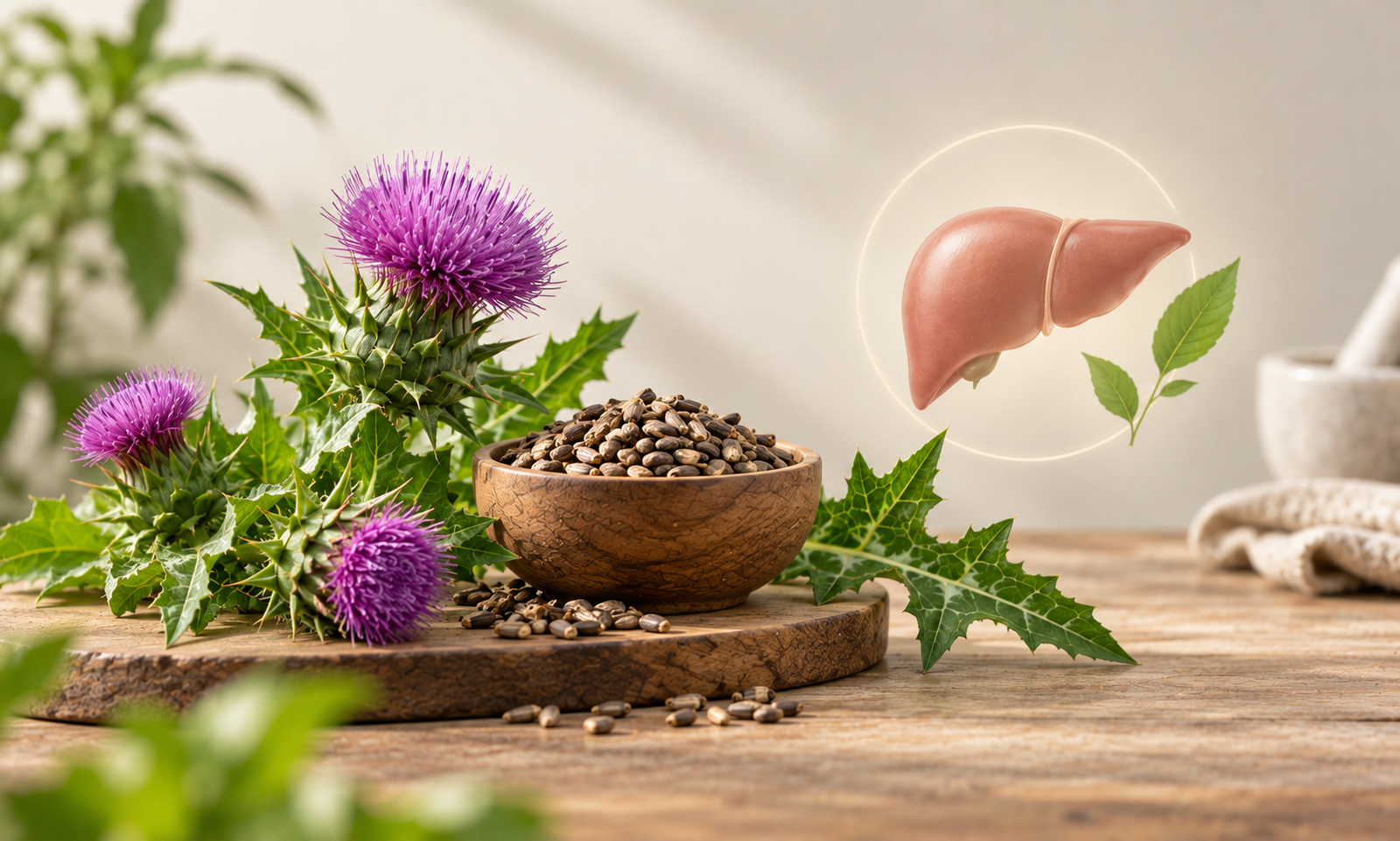
Milk thistle (Silybum marianum) is a flowering plant traditionally associated with liver health and is now widely studied as a source of silymarin, a group of flavonolignans that includes silybin, silychristin and silydianin. Modern research has investigated silymarin for its antioxidant, anti-inflammatory and potentially hepatoprotective properties.
The term “liver detox” is commonly used in herbal-health discussions, but it should be interpreted carefully. The liver already performs its own detoxification and metabolic functions, and there is currently no strong clinical evidence that milk thistle can “clean” the liver or reverse the effects of unhealthy habits on its own. Instead, research has focused on whether silymarin can influence liver enzymes, oxidative stress, inflammation and other markers associated with liver disease.
Clinical evidence remains mixed. Some recent systematic reviews and meta-analyses of randomized controlled trials report improvements in ALT, AST and certain metabolic markers among people taking silymarin. However, other systematic reviews and major evidence summaries conclude that the clinical significance of these changes remains uncertain. Studies of hepatitis C and non-alcoholic fatty liver disease have not consistently demonstrated meaningful improvements in disease outcomes.
Milk thistle appears to be generally well tolerated when taken orally, although gastrointestinal symptoms and allergic reactions can occur, and supplement quality can vary. This article examines the scientific evidence behind milk thistle, its potential role in liver support, its limitations and important safety considerations.
What Is Milk Thistle?
Milk thistle is scientifically known as Silybum marianum and is also called Mary thistle or holy thistle. It is a flowering plant belonging to the Asteraceae family.
The seeds and fruits of the plant contain a mixture of flavonolignans collectively referred to as silymarin. The principal compounds include silybin, silychristin and silydianin. Silybin is generally considered one of the major biologically active components of silymarin.
Milk thistle has historically been used for liver-related complaints, and today it is commonly marketed as a dietary supplement for liver health. The National Center for Complementary and Integrative Health (NCCIH) notes that milk thistle is widely promoted for liver disorders but also emphasizes that there is not yet enough high-quality evidence to reach definite conclusions about its effectiveness for liver disease.
This distinction is important when discussing a Herbal liver detox formula. Traditional use and commercial claims can provide a reason for scientific investigation, but they do not by themselves establish clinical effectiveness.
How Does Silymarin Work?
Researchers have proposed several mechanisms through which silymarin may influence liver cells.
Laboratory and animal studies suggest that silymarin can interact with pathways involved in oxidative stress and inflammation. Oxidative stress occurs when the production of reactive molecules exceeds the body’s antioxidant defenses. Excessive oxidative stress can contribute to cellular damage and inflammatory processes.
Silymarin has demonstrated antioxidant activity in experimental research, while studies have also investigated effects on inflammatory signaling, cellular stress responses and fibrotic pathways.
However, laboratory activity should not automatically be interpreted as a proven clinical effect.
A substance can show strong antioxidant activity in a test tube and still produce little measurable improvement in people with chronic liver disease. This is one reason randomized controlled clinical trials are important when evaluating herbal medicines.
Can Milk Thistle Really “Detox” the Liver?
The word detox needs some clarification.
The liver naturally processes numerous substances through enzymatic pathways and works continuously as part of the body’s metabolic and elimination systems. There is no established medical requirement to periodically “cleanse” a healthy liver with a supplement.
Milk thistle should therefore not be described as a substance that physically removes toxins from the liver.
A more scientifically appropriate description is that silymarin is being investigated for potential hepatoprotective effects. Researchers have studied whether it can influence oxidative stress, inflammation and biochemical markers associated with liver injury.
This distinction is particularly important for consumer education. A product marketed as an ayurvedic medicine for liver health or a Herbal liver detox formula should not imply that it can counteract excessive alcohol consumption, unhealthy dietary patterns, medication toxicity or established liver disease without supporting clinical evidence.
What Does Clinical Research Show?
Clinical research on milk thistle has produced mixed results.
An early systematic review and meta-analysis published in 2002 evaluated 14 randomized placebo-controlled trials involving people with liver disease. The researchers found no significant improvement in mortality, liver histology, albumin or several biochemical measures. A small reduction in ALT was observed in some analyses, but the authors considered the clinical importance negligible. They concluded that the evidence was insufficient to recommend milk thistle as a treatment for liver disease.
A Cochrane review published in 2005 examined 13 randomized clinical trials involving 915 people with alcoholic liver disease and/or hepatitis B or C. The review found no significant effect on overall mortality, complications or liver histology in the higher-quality trials. The authors concluded that evidence from rigorous trials did not establish a significant effect on the clinical course of these diseases.
These older studies remain important because they demonstrate that the long history of milk thistle use does not automatically translate into proven clinical effectiveness.
What Do More Recent Meta-Analyses Show?
More recent research provides a somewhat more encouraging picture, particularly concerning liver enzymes.
A 2023 systematic review examined 29 randomized clinical trials involving 3,846 participants. The review reported that 65.5% of the included studies observed reductions in liver enzymes, although other studies found no significant change or even increases. The researchers concluded that silymarin may have hepatoprotective potential but emphasized that the response appears to depend on the underlying condition, dosage and individual characteristics.
Another systematic review and dose-response meta-analysis published in 2024 included 41 randomized controlled trials. The pooled analysis reported significant reductions in ALT, AST and alkaline phosphatase among people receiving silymarin. The authors also noted that additional high-quality, longer-duration trials are required to determine its clinical efficacy.
These findings suggest that silymarin may influence biochemical markers of liver function, but improvement in a laboratory value is not necessarily equivalent to preventing fibrosis, reversing cirrhosis or improving survival.
That distinction should remain clear whenever milk thistle is discussed in health content.
Milk Thistle and Fatty Liver
Milk thistle has also been investigated in metabolic fatty liver disease.
A 2024 systematic review and meta-analysis included 26 randomized controlled trials involving 2,375 patients with NAFLD. The researchers reported improvements in several metabolic markers, including total cholesterol, triglycerides and LDL cholesterol, as well as reductions in ALT and AST. The analysis also reported improvements in fatty-liver index, fatty-liver score and hepatic steatosis in the available studies.
However, these findings should be interpreted cautiously.
Different studies used different preparations, doses and treatment durations, and not every clinical trial has produced the same results. NCCIH specifically notes that clinical trials of milk thistle for NAFLD and other liver diseases have produced conflicting or insufficient evidence. Two NCCIH-supported trials, including one involving non-alcoholic steatohepatitis, did not demonstrate benefits from silymarin supplementation.
Consequently, milk thistle may be a promising area of research, but it is not currently established as a stand-alone treatment for fatty liver disease.
Milk Thistle and Alcohol-Related Liver Disease
Milk thistle has traditionally been associated with liver protection, including in people who consume alcohol.
However, evidence does not show that taking milk thistle makes alcohol consumption safe or prevents alcohol-related liver damage.
A systematic review of randomized trials involving alcoholic liver disease found no convincing evidence that milk thistle significantly altered the overall clinical course of the disease in high-quality studies.
The appropriate approach for people concerned about alcohol-associated liver disease is therefore to address alcohol exposure itself rather than attempting to counteract it with an herbal supplement.
People with established alcohol-associated liver disease should receive appropriate medical evaluation and management.
Potential Benefits of Milk Thistle
Based on the available research, several potential areas of interest have emerged.
- Antioxidant activity: Experimental studies suggest that silymarin can influence oxidative-stress pathways and antioxidant defenses.
- Potential effects on liver enzymes: Several meta-analyses have reported reductions in ALT and AST among people taking silymarin, although the size and clinical importance of these changes vary.
- Anti-inflammatory and antifibrotic research: Laboratory and animal studies have investigated effects on inflammatory and fibrotic signaling pathways, although clinical evidence for meaningful antifibrotic effects remains insufficient.
- General tolerability: Clinical studies generally indicate that oral milk thistle is well tolerated, with adverse effects usually being mild when they occur.
These potential benefits should be described as areas of scientific investigation rather than guaranteed health outcomes.
Is Milk Thistle Safe?
Available evidence suggests that milk thistle is generally well tolerated when taken orally.
NCCIH reports that commonly reported side effects include digestive symptoms such as bloating, nausea and gas. Allergic reactions are also possible, particularly in people who are sensitive to related plants in the Asteraceae family.
The NCBI LiverTox database classifies milk thistle as an unlikely cause of clinically apparent liver injury. Despite its widespread use, it has not been convincingly associated with significant serum enzyme elevations or acute liver injury.
This is an important distinction: a product can have a relatively favorable safety profile while still having uncertain therapeutic effectiveness.
Another concern is supplement quality. NCCIH reports that some milk-thistle products have contained substantially different amounts of silymarin from what was stated on their labels, while contamination with pesticides, microorganisms or mycotoxins has also been reported.
Therefore, choosing a properly manufactured and quality-controlled product is important.
Can Milk Thistle Be Taken With Other Medicines?
Anyone taking prescription medicines should discuss milk thistle supplementation with a healthcare professional.
Laboratory research has suggested that silymarin may influence certain cytochrome P450 enzymes and hepatic transporters, although LiverTox notes that there is little evidence demonstrating clinically significant herb–drug interactions in practice.
The uncertainty is particularly relevant for people taking multiple medicines or those with chronic liver disease.
Pregnant and breastfeeding individuals should also seek professional advice because safety information for these populations remains limited.
Milk Thistle as Part of a Broader Liver-Health Approach
Milk thistle should not be viewed in isolation.
For people interested in an ayurvedic medicine for liver health, a Herbal liver detox formula, or a Herbal Unani liver tonic, the most important principles remain healthy nutrition, appropriate physical activity, maintaining a healthy body weight, avoiding excessive alcohol and addressing medical conditions that affect liver health.
An herbal supplement may be considered as a complementary option where appropriate, but it should not replace diagnosis or evidence-based treatment.
The same principle is relevant to Shahi Herbal: responsible herbal-health communication should explain what an ingredient has traditionally been used for, what modern studies have actually demonstrated, and where evidence remains uncertain.
What Does the Science Currently Tell Us?
Milk thistle and its principal extract, silymarin, have a substantial history of traditional use and modern scientific investigation. Laboratory research provides plausible mechanisms involving antioxidant and anti-inflammatory activity, while several recent meta-analyses report improvements in liver enzymes and selected metabolic markers.
At the same time, major evidence reviews and NCCIH conclude that the clinical evidence remains inconsistent or insufficient to establish milk thistle as an effective treatment for liver disease.
The most scientifically responsible description is therefore that milk thistle may support certain biochemical aspects of liver health, but its ability to produce meaningful clinical improvements in liver disease has not been conclusively established.
For consumers, this means that milk thistle can be an interesting herbal option to discuss with a healthcare professional, but the concept of “liver detox” should not replace evidence-based liver care.
Reference
- National Center for Complementary and Integrative Health (NCCIH). Milk Thistle: Usefulness and Safety. Updated February 2025. National Institutes of Health. (nccih.nih.gov)
- Jacobs BP, Dennehy C, Ramirez G, Sapp J, Lawrence VA. Milk thistle for the treatment of liver disease: a systematic review and meta-analysis. American Journal of Medicine. 2002;113(6):506–515. PMID: 12427501; DOI: 10.1016/S0002-9343(02)01244-5.
- Rambaldi A, Jacobs BP, Iaquinto G, Gluud C. Milk thistle for alcoholic and/or hepatitis B or C liver diseases—a systematic Cochrane Hepato-Biliary Group review with meta-analyses of randomized clinical trials. American Journal of Gastroenterology. 2005;100(11):2583–2591. PMID: 16279916; DOI: 10.1111/j.1572-0241.2005.00262.x.
- Saller R, Brignoli R, Melzer J, Meier R. An updated systematic review with meta-analysis for the clinical evidence of silymarin. Forschende Komplementärmedizin. 2008;15(1):9–20. PMID: 18334810; DOI: 10.1159/000113648.
- Calderon Martinez D, et al. Impact of Silymarin Supplements on Liver Enzyme Levels: A Systematic Review. 2023. PMID: 38021897.
- Effects of silymarin supplementation on liver and kidney functions: A systematic review and dose-response meta-analysis. 2024. PMID: 38475999.
- Administration of silymarin in NAFLD/NASH: A systematic review and meta-analysis. 2024. PMID: 38579127; DOI: 10.1016/j.aohep.2023.101174.
- Effect of silymarin on biochemical indicators in patients with liver disease: Systematic review with meta-analysis. 2017. PMID: 28785154.
- NCBI LiverTox. Milk Thistle. National Library of Medicine. Updated resource on silymarin, clinical evidence, adverse effects and hepatotoxicity.
Keywords: ayurvedic medicine for liver health, Herbal liver detox formula, Herbal Unani liver tonic, Shahi Herbal, milk thistle, Silybum marianum, silymarin, milk thistle benefits, milk thistle for liver health, natural liver support, herbal liver support, liver detox, liver health


