
Abstract
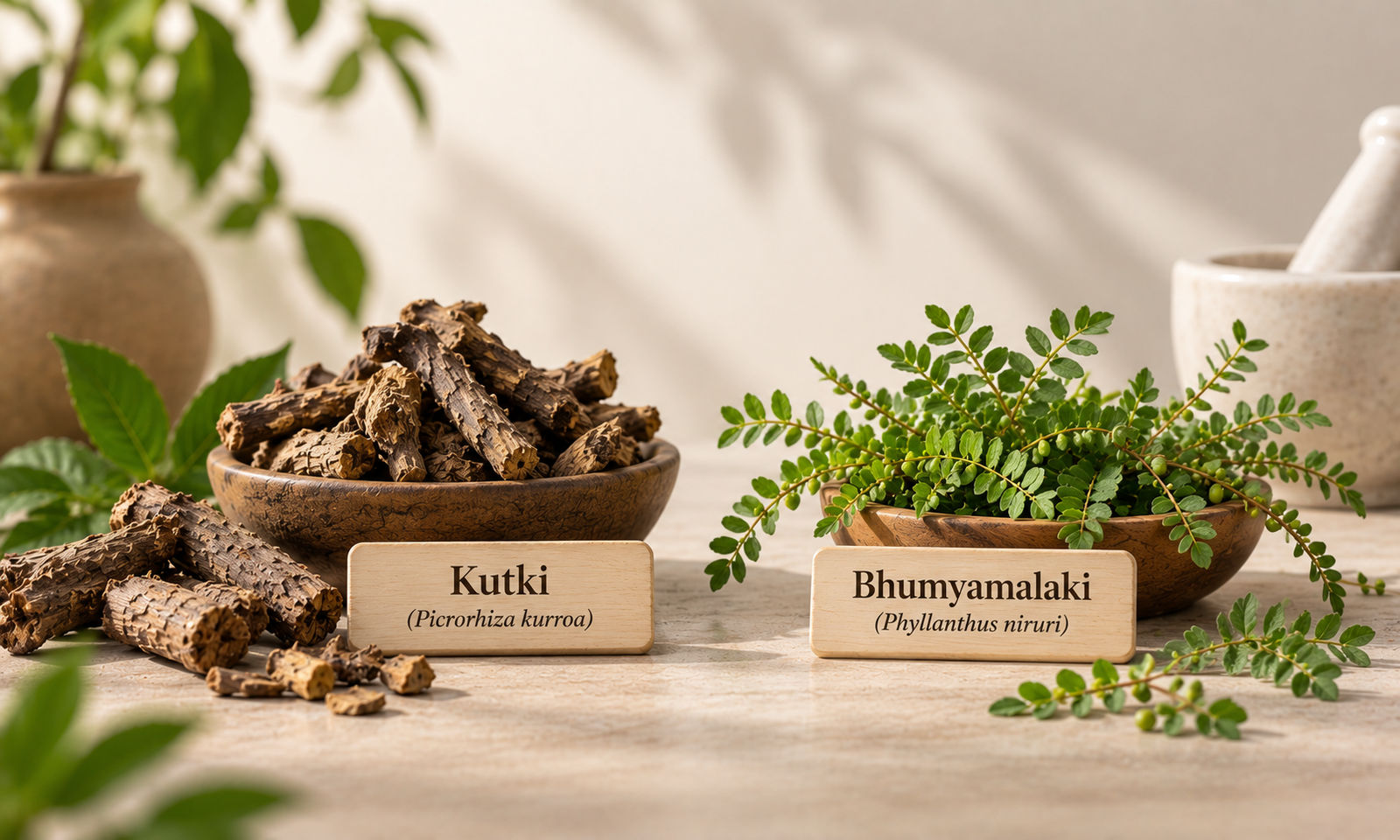
Kutki (Picrorhiza kurroa) and Bhumyamalaki, a traditional name used for several Phyllanthus species, are among the Ayurvedic herbs most closely associated with liver care. Both have a long history of traditional use, while modern researchers have investigated their phytochemistry, antioxidant activity, hepatoprotective effects and potential applications in liver disorders.
Kutki contains iridoid glycosides, particularly picrosides, which have been investigated in experimental models and clinical studies for hepatoprotective and anti-inflammatory effects. Early clinical research involving patients with acute viral hepatitis reported improvements in bilirubin and transaminase measures, while later reviews have identified Kutki as a promising candidate for further research in fatty liver and other liver conditions.
Bhumyamalaki presents a more complicated scientific picture because the name is used for multiple Phyllanthus species, including P. amarus, P. niruri and related plants. Research has identified numerous potentially bioactive compounds and reported hepatoprotective activity, but clinical findings have not been consistently positive.
Current evidence suggests that both herbs are scientifically interesting, but neither should be presented as a universally proven treatment or substitute for medical care. Botanical identification, product quality, appropriate dosage and clinical supervision remain important considerations.
The Ayurvedic Tradition of Liver Support
Ayurveda has traditionally used numerous plants in formulations intended to support digestion, metabolism and liver-related health. Among these, Kutki and Bhumyamalaki have received particular attention because of their historical association with jaundice and other liver complaints.
Modern research has attempted to investigate these traditional applications using pharmacological studies, animal models and clinical trials. Reviews of Indian medicinal plants have identified Picrorhiza kurroa and Phyllanthus amarus among the plants with substantial research into potential hepatoprotective effects.
However, traditional use and modern clinical evidence are not identical. A plant may have a long history of traditional application while still requiring additional research to establish its effectiveness for a specific modern diagnosis.
This distinction is particularly important when discussing an ayurvedic medicine for liver health. Evidence about an individual herb does not automatically establish the effectiveness of every formulation containing that herb.
Kutki: The Traditional Liver Herb
Kutki, botanically known as Picrorhiza kurroa Royle ex Benth, is a small medicinal plant traditionally used in Ayurveda. Its underground parts, particularly the roots and rhizomes, contain characteristic iridoid glycosides, including picroside I, picroside II and kutkoside.
These compounds have been the subject of extensive phytochemical and pharmacological investigation. Researchers have explored their antioxidant, anti-inflammatory, hepatoprotective and other biological activities.
One reason Kutki continues to attract attention is that its traditional use has been accompanied by efforts to identify and standardize its active constituents. Standardization is important because the chemical composition of an herbal preparation can influence its biological activity.
A 2022 review described P. kurroa as a traditional Ayurvedic herb with experimental and clinical evidence suggesting hepatoprotective activity. The researchers specifically discussed picrosides and the importance of pharmaceutical standardization, regulation, safety evaluation and appropriate dosage in translating traditional use into modern therapeutic products.
What Does Research Say About Kutki?
Kutki has been studied in both laboratory models and human clinical research.
One of the earlier clinical studies was a randomized, double-blind, placebo-controlled trial involving patients diagnosed with acute viral hepatitis who were negative for HBsAg. Participants received P. kurroa root powder or placebo for two weeks. The study reported significant differences in bilirubin and transaminase values between the groups, with the Kutki group showing a faster reduction in serum bilirubin to the predefined level.
This study is scientifically interesting because it provides human clinical evidence rather than relying exclusively on animal experiments. However, it was relatively small, involving only 33 patients, and it examined a particular preparation for a particular clinical condition.
It therefore cannot establish that Kutki can treat every form of liver disease.
Later research has continued to investigate Kutki’s potential in fatty liver disease. A comprehensive 2022 review specifically examined its traditional use, phytochemistry, pharmacology and translational potential for fatty liver disease. The authors suggested that phytochemically standardized preparations could be investigated further, while emphasizing the need for formal regulation, safety evaluation and appropriate clinical development.
Another review covering research from 2010 to 2020 described hepatoprotective, antioxidant and anti-inflammatory activities associated with P. kurroa and its constituents, while also discussing conservation and safety considerations.
Why Picrosides Matter
The scientific interest in Kutki is partly connected to its characteristic iridoid glycosides.
Picroside I and picroside II are among the principal compounds used in the chemical characterization of P. kurroa. Researchers have investigated these compounds in experimental models of liver injury and have attempted to relate their biological activities to the traditional hepatoprotective reputation of Kutki.
This illustrates an important development in modern herbal medicine: researchers are not only studying whether a traditional herb appears to work but are also examining which constituents may contribute to its activity and how standardized preparations can be produced.
For manufacturers of herbal products, this type of research is particularly relevant because botanical identity and chemical consistency can affect the reproducibility of a formulation.
Bhumyamalaki: A More Complex Botanical Story
Bhumyamalaki is traditionally associated with small Phyllanthus plants used in Ayurvedic medicine for liver-related conditions.
However, there is an important scientific qualification: Bhumyamalaki is not always represented by one single botanical species in commercial or traditional practice.
Research examining Ayurvedic botanical material has found that several Phyllanthus species may be sold or identified under the name Bhumyamalaki. These include Phyllanthus amarus, P. fraternus and P. maderaspatensis. Researchers have demonstrated that these species can be distinguished through morphological, microscopic and chromatographic characteristics.
This matters because different species may have different chemical compositions and therefore potentially different biological effects.
A 2025 study also emphasized the possibility of species substitution or incorrect identification within the Phyllanthus genus and used microscopic, macroscopic and HPTLC fingerprinting methods to authenticate P. amarus samples.
Therefore, when discussing a Bhumyamalaki-based Herbal liver detox formula, botanical authentication should be considered an important quality factor.
What Compounds Are Found in Bhumyamalaki?
Research on the Phyllanthus genus has identified a wide variety of phytochemicals, including lignans, alkaloids, terpenoids, flavonoids and tannins.
Some compounds identified in Phyllanthus species, including phyllanthin, hypophyllanthin, quercetin, gallic acid and ellagic acid derivatives, have demonstrated antioxidant or hepatoprotective activity in experimental research.
A comprehensive review of P. niruri similarly summarized research involving antioxidant, anti-inflammatory, antiviral and hepatoprotective activities. However, the authors noted substantial variation among studies and emphasized that differences in experimental methods and reporting make direct comparison difficult.
This means that the biochemical potential of Bhumyamalaki is scientifically interesting, but biological activity in a laboratory should not automatically be interpreted as proven clinical efficacy.
Bhumyamalaki and Human Liver Research
Clinical research involving Phyllanthus species has produced mixed results.
A double-blind randomized controlled trial evaluated Phyllanthus niruri in patients with mild-to-moderate alcoholic hepatitis. Seventy-one participants were included in the final modified intention-to-treat analysis. After four weeks, the researchers did not find significant improvements in liver or renal function parameters compared with placebo, although an increase in total antioxidant levels was observed.
Another randomized, placebo-controlled study examined standardized P. niruri extract in people with mild-to-moderate non-alcoholic fatty liver disease over 12 months. The study included more than 200 randomized participants and evaluated liver fat using controlled attenuation parameter measurements, together with liver enzymes and metabolic markers.
These studies demonstrate why it is important to examine the actual clinical evidence rather than relying only on traditional reputation.
Earlier studies of P. amarus in hepatitis B also produced mixed findings. One randomized controlled study involving 65 chronic hepatitis B carriers found only a minimal effect on hepatitis B surface antigen clearance at the studied dose and duration.
Another randomized trial in acute hepatitis B found that P. amarus did not significantly reduce the duration of jaundice compared with placebo.
Consequently, Bhumyamalaki should not be marketed as a proven cure for hepatitis or other liver diseases solely on the basis of traditional use.
Kutki vs Bhumyamalaki: What Makes Them Different?
Kutki and Bhumyamalaki are both traditionally associated with liver care, but their botanical identities and research profiles are different.
Kutki is a single recognized species, Picrorhiza kurroa, with characteristic iridoid glycosides such as picrosides. Research has focused substantially on hepatoprotective mechanisms and standardization of these compounds.
Bhumyamalaki, by contrast, represents a group of Phyllanthus plants used in traditional practice. This creates an additional quality-control challenge because different species may be confused or substituted for one another.
Both herbs have promising experimental evidence, but clinical evidence remains formulation- and condition-specific.
For this reason, comparing the herbs simply by asking which one is “stronger” would not be scientifically appropriate. The more useful questions are: Which species is present? What preparation and dose were studied? What condition was investigated? Was the study performed in humans? How long was the intervention used?
Potential Role in Modern Liver Care
The growing scientific interest in Kutki and Bhumyamalaki does not mean that they should replace conventional diagnosis or treatment.
Liver disease can result from many causes, including metabolic dysfunction, viral infections, alcohol, autoimmune conditions, genetic disorders and medication-related injury. The appropriate treatment therefore depends on the underlying cause.
For people concerned about fatty liver, lifestyle measures remain particularly important. Herbal products cannot substitute for weight management, regular physical activity, appropriate nutrition and management of metabolic risk factors.
Similarly, someone considering a Herbal Unani liver tonic should understand that evidence for a particular Ayurvedic herb cannot automatically be transferred to a Unani formulation containing different ingredients.
The same principle applies to products marketed by Shahi Herbal: the most scientifically responsible approach is to describe the traditional role of individual herbs while clearly distinguishing traditional knowledge from evidence generated through human clinical studies.
Safety and Quality Considerations
“Herbal” does not automatically mean risk-free.
The safety of a liver-support product depends on its botanical identity, preparation method, dose, duration of use, manufacturing quality and the health status of the person taking it.
Kutki research has specifically highlighted the importance of standardization, pharmaceutical quality, regulation and ethical prescribing when developing traditional remedies into modern products.
For Bhumyamalaki, authentication is particularly important because multiple Phyllanthus species may enter the supply chain under similar traditional names.
People with diagnosed liver disease, those taking prescription medicines, pregnant or breastfeeding individuals, and people with other chronic medical conditions should seek appropriate professional advice before using concentrated herbal preparations.
Quality-controlled products should provide clear information about the botanical ingredients, formulation, recommended dosage, manufacturing details and appropriate precautions.
What Current Evidence Really Tells Us
Kutki and Bhumyamalaki represent two good examples of how traditional Ayurvedic knowledge is being examined through modern pharmacological and clinical research.
Kutki has a relatively well-defined botanical identity and a substantial body of experimental research around picrosides, together with some human clinical evidence. Bhumyamalaki and related Phyllanthus species have demonstrated considerable pharmacological potential, particularly in laboratory studies, but botanical variation and mixed clinical findings make careful interpretation especially important.
Neither herb should be described as a guaranteed liver cleanser or universal treatment for liver disease. Instead, they can be discussed as traditional medicinal plants with promising but condition-specific scientific evidence.
For modern herbal medicine, the combination of traditional knowledge, botanical authentication, chemical standardization, controlled clinical research and pharmacovigilance offers a more reliable path toward responsible liver care.
Reference
- Vaidya AB, Antarkar DS, Doshi JC, et al. Picrorhiza kurroa (Kutaki) Royle ex Benth as a hepatoprotective agent—experimental & clinical studies. Journal of Postgraduate Medicine. 1996;42(4):105–108. PMID: 9715310.
- Almeleebia TM, Alsayari A, Wahab S. Pharmacological and Clinical Efficacy of Picrorhiza kurroa and Its Secondary Metabolites: A Comprehensive Review. Molecules. 2022;27(23):8316. DOI: 10.3390/molecules27238316; PMID: 36500409; PMCID: PMC9738980.
- Vaidya AB, et al. Picrorhiza kurroa, Royle ex Benth: Traditional uses, phytopharmacology, and translational potential in therapy of fatty liver disease. Journal of Ayurveda and Integrative Medicine. 2022. DOI: 10.1016/j.jaim.2022.100558; PMID: 35659739; PMCID: PMC10105242.
- Verma PC, Basu V, Gupta V, Saxena G, Rahman LU. Pharmacology and chemistry of a potent hepatoprotective compound Picroliv isolated from the roots and rhizomes of Picrorhiza kurroa Royle ex Benth (Kutki). Current Pharmaceutical Biotechnology. 2009;10(6):641–649. DOI: 10.2174/138920109789069314; PMID: 19619118.
- Sharma SK, Sheela MA. Pharmacognostic evaluation of leaves of certain Phyllanthus species used as a botanical source of Bhumyamalaki in Ayurveda. AYU. 2011;32(2):250–253. DOI: 10.4103/0974-8520.92552; PMID: 22408311; PMCID: PMC3296349.
- Kumar S, et al. Phytochemical profile and hepatoprotective potentiality of Phyllanthus genus: a review. Journal of Pharmacy and Pharmacology. 2024. DOI: 10.1093/jpp/rgae040; PMID: 38642916.
- Kaur N, Kaur B, Sirhindi G. Phytochemistry and Pharmacology of Phyllanthus niruri L.: A Review. Phytotherapy Research. 2017;31(7):980–1004. DOI: 10.1002/ptr.5825; PMID: 28512988.
- Sowjanya K, Girish C, Bammigatti C, et al. Efficacy of Phyllanthus niruri on improving liver functions in patients with alcoholic hepatitis: A double-blind randomized controlled trial. Indian Journal of Pharmacology. 2021;53(6):448–456. DOI: 10.4103/ijp.IJP_540_20; PMID: 34975132; PMCID: PMC8764976.
- Baiguera C, Boschetti A, Raffetti E, et al. Phyllanthus niruri versus Placebo for Chronic Hepatitis B Virus Infection: A Randomized Controlled Trial. Liver International. 2018;25(6):376–382. DOI: 10.1159/000484927; PMID: 30372693.
- Thamlikitkul V, Wasuwat S, Kanchanapee P. Efficacy of Phyllanthus amarus for eradication of hepatitis B virus in chronic carriers. Journal of the Medical Association of Thailand. 1991;74(9):381–385. PMID: 1791391.
- Narendranathan M, Remla A, Mini PC, Satheesh P. A trial of Phyllanthus amarus in acute viral hepatitis. Tropical Gastroenterology. 1999;20(4):164–166. PMID: 10769603.
- Chinchansure AA, Anugamini A, Ananda L. Identification of authentic Phyllanthus amarus species in India. Natural Product Research. 2025;39(9):2625–2629. DOI: 10.1080/14786419.2024.2313190; PMID: 38315581.
Keywords: ayurvedic medicine for liver health, Herbal liver detox formula, Herbal Unani liver tonic, Shahi Herbal, Kutki, Picrorhiza kurroa, Bhumyamalaki, Phyllanthus niruri, Phyllanthus amarus, Ayurvedic herbs for liver, herbal liver support, liver health, hepatoprotective herbs


